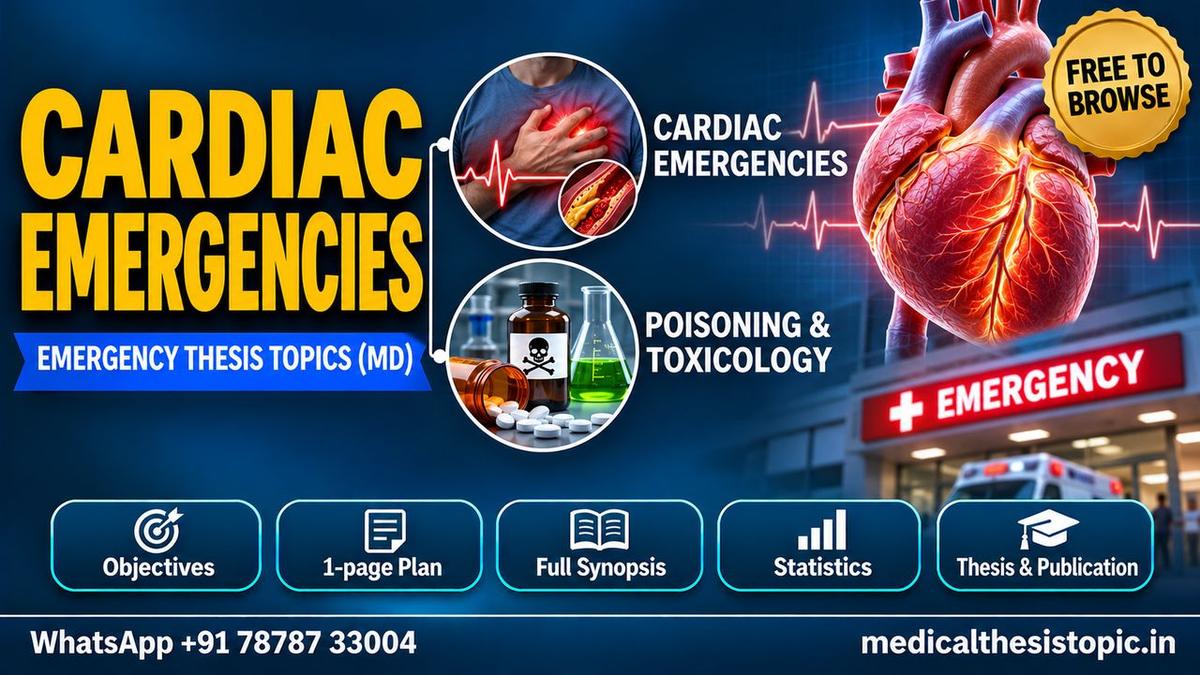
MD Emergency Medicine (Cardiac Emergencies and Poisoning & Toxicology) — Thesis Title List
35 titles · instant objectives
-
001
Door-to-ECG and door-to-needle times in acute ST-elevation myocardial infarction: an emergency department audit
Cardiac Emergencies
Prospective audit
Audit
-
002
HEART score for risk stratification of chest pain in the emergency department: a prospective validation
Cardiac Emergencies
Prospective observational study
Validation Study
-
003
Point-of-care troponin versus laboratory troponin for early rule-out of acute myocardial infarction
Cardiac Emergencies
Prospective diagnostic study
Diagnostic Accuracy Study
-
004
Outcome of in-hospital and out-of-hospital cardiac arrest patients receiving CPR in the emergency department
Cardiac Emergencies
Prospective observational study
Descriptive Study
-
005
Point-of-care echocardiography by emergency physicians in undifferentiated dyspnoea: diagnostic accuracy and impact on management
Cardiac Emergencies
Prospective diagnostic study
Diagnostic Accuracy Study
-
006
Clinical profile and outcome of patients presenting with acute pulmonary oedema to the emergency department
Cardiac Emergencies
Prospective observational study
Descriptive Study
-
007
Clinical profile, severity scoring and outcome of organophosphorus poisoning in the emergency department
Poisoning & Toxicology
Prospective observational study
Prospective Study
-
008
Pattern of acute poisoning and factors predicting ICU admission and mortality at a tertiary care emergency department
Poisoning & Toxicology
Prospective observational study
Descriptive Study
-
009
Clinical profile and outcome of snakebite envenomation and time to anti-snake venom administration
Poisoning & Toxicology
Prospective observational study
Prospective Study
-
010
Clinical spectrum and outcome of aluminium phosphide poisoning: a prospective study
Poisoning & Toxicology
Prospective observational study
Prospective Study
-
011
Poisoning Severity Score versus APACHE II in predicting outcome in acute poisoning
Poisoning & Toxicology
Prospective observational study
Validation Study
-
012
Clinical profile and outcome of scorpion sting envenomation and role of prazosin
Poisoning & Toxicology
Prospective observational study
Prospective Study
-
013
EDACS-ADP versus HEART score for safe early discharge of patients with chest pain
Cardiac Emergencies
Prospective observational study
Validation Study
-
014
Accuracy of emergency physician point-of-care ultrasound for pericardial effusion and regional wall motion abnormality
Cardiac Emergencies
Prospective diagnostic study
Diagnostic Accuracy Study
-
015
Aortic dissection detection risk score with D-dimer for ruling out acute aortic syndrome in the emergency department
Cardiac Emergencies
Prospective diagnostic study
Diagnostic Accuracy Study
-
016
Validation of the Canadian Syncope Risk Score in patients presenting with syncope to the emergency department
Cardiac Emergencies
Prospective observational study
Validation Study
-
017
Clinical profile, management and outcome of symptomatic bradycardia in the emergency department
Cardiac Emergencies
Prospective observational study
Descriptive Study
-
018
Modified versus standard Valsalva manoeuvre for conversion of supraventricular tachycardia
Cardiac Emergencies
Randomised comparative trial
Comparative Study
-
019
Wells score, D-dimer and bedside leg ultrasound for diagnosis of pulmonary embolism in the emergency department
Cardiac Emergencies
Prospective diagnostic study
Diagnostic Accuracy Study
-
020
Clinical pattern and predictors of mortality in glyphosate-surfactant herbicide poisoning
Poisoning & Toxicology
Prospective observational study
Prognostic Study
-
021
20-minute whole blood clotting test versus point-of-care D-dimer for haemostatic envenomation after snakebite
Poisoning & Toxicology
Prospective diagnostic study
Diagnostic Accuracy Study
-
022
Severity index of paraquat poisoning as a predictor of mortality
Poisoning & Toxicology
Prospective observational study
Prognostic Study
-
023
Clinical profile and endoscopic grading as predictors of outcome in corrosive ingestion
Poisoning & Toxicology
Prospective observational study
Descriptive Study
-
024
Clinical profile and outcome of paraphenylenediamine hair dye poisoning
Poisoning & Toxicology
Prospective observational study
Descriptive Study
-
025
Predictors of need for mechanical ventilation in neurotoxic snakebite envenomation
Poisoning & Toxicology
Prospective observational study
Prognostic Study
-
026
INR and MELD score as predictors of mortality in yellow phosphorus rodenticide poisoning
Poisoning & Toxicology
Prospective observational study
Prognostic Study
-
027
Diagnostic accuracy of the high-sensitivity troponin I 0/1-hour algorithm for rule-out of non-ST-elevation myocardial infarction in the emergency department
Cardiac Emergencies
Prospective diagnostic study
Diagnostic Accuracy Study
-
028
Occlusion myocardial infarction ECG patterns in chest pain patients without STEMI criteria and their correlation with angiographic culprit occlusion
Cardiac Emergencies
Prospective diagnostic study
Diagnostic Study
-
029
Lung ultrasound B-line count at emergency department discharge as a predictor of 30-day readmission in acute heart failure
Cardiac Emergencies
Prospective observational study
Prognostic Study
-
030
Clinical profile and outcome of amitraz, fipronil and chlorophenoxy herbicide poisonings mimicking organophosphate toxicity in the emergency department
Poisoning & Toxicology
Prospective observational study
Descriptive Study
-
031
Rotational thromboelastometry versus 20-minute whole blood clotting test for detection of venom-induced coagulopathy in haemotoxic snakebite
Poisoning & Toxicology
Prospective diagnostic study
Diagnostic Accuracy Study
-
032
Clinical profile and outcome of acquired methaemoglobinaemia due to drugs and chemicals presenting to the emergency department
Poisoning & Toxicology
Prospective observational study
Descriptive Study
-
033
Ibutilide versus amiodarone for pharmacological cardioversion of recent-onset atrial fibrillation in the emergency department
Cardiac Emergencies
Randomised comparative trial
Comparative Study
-
034
Clinical profile, antivenom use and adverse reactions in hump-nosed pit viper envenomation presenting to the emergency department
Poisoning & Toxicology
Retrospective record-based study
Descriptive Study
-
035
Clinical profile and outcome of neonicotinoid insecticide poisoning presenting to the emergency department
Poisoning & Toxicology
Prospective observational study
Descriptive Study